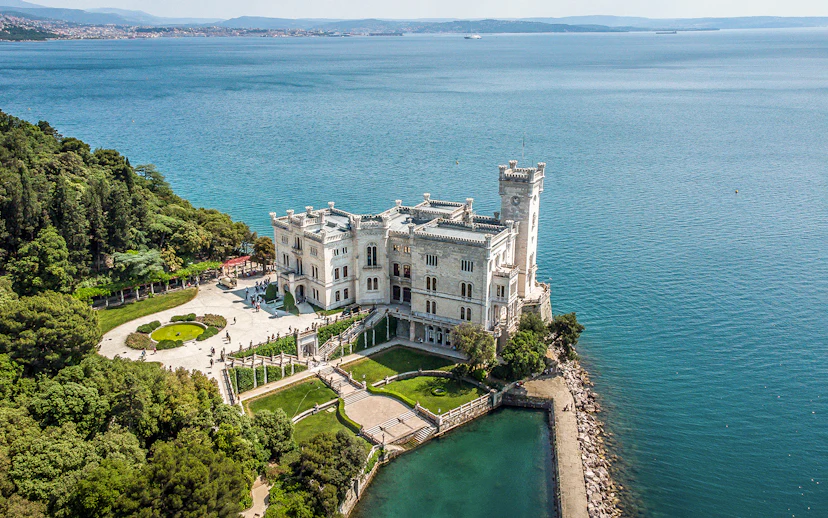
Plan your visit to Miramare Castle
Miramare Castle is a 19th-century Habsburg seaside residence best known for its furnished rooms and dramatic setting above the Gulf of Trieste. The visit is more atmospheric than overwhelming: the interior route is compact, but most people stay longer because the free 22-hectare park, sea views, and photo stops stretch the outing into a half-day. The biggest difference between a rushed visit and a good one is planning the interior and park together. This guide covers timing, entrances, tickets, and the route that makes the day feel easy.
Quick overview: Miramare Castle at a glance
If you want the short version before choosing a ticket or transport, start here.
- When to visit: Tuesday–Sunday, 9am–7pm. Weekday mornings in May, June, and September are noticeably calmer than summer afternoons and free first Sundays, because parking pressure, bus arrivals, and same-day visitors all stack up at once.
- Getting in: From €17 for standard entry to the historical museum route and current public exhibition bundle. Special guided add-on visits to the Castelletto and historic kitchens start at €7, and booking ahead matters most on weekends, holidays, and free first Sundays.
- How long to allow: 2–3 hours for most visitors. It stretches toward the longer end if you add the park, café stop, or Scuderie exhibition.
- What most people miss: The Chinese Drawing Room and Maximilian’s study reward a slower look, and the parterre is the best reset point after the interior rather than just a quick photo stop on the way in.
- Is a guide worth it? Yes if you care about Maximilian, Charlotte, and the castle’s later wartime and Savoy layers; otherwise the official audio guide does enough for a first self-guided visit at lower cost.
🎟️ Tickets for Miramare Castle are most at risk of delays and capacity checks on peak weekends, holidays, and free first Sundays. Lock in your visit before the time you want is gone. See ticket options.
Jump to what you need
🕒 Where and when to go
🗓️ How much time do you need?
🎟️ Which ticket is right for you?
🗺️ Getting around
♿ Facilities and accessibility
Where and when to go
How do you get to Miramare Castle?
Miramare Castle sits on the Grignano promontory, about 8km north-west of central Trieste, and the final approach matters more than the city-to-site distance.
Viale Miramare, 34151 Trieste, Italy
- Bus: Lines 6 and 36 from Trieste → Grignano/Miramare area stop → about 10–15 min downhill walk → check the stop and descent before you get off, because wayfinding is weaker than first-timers expect.
- Train: Trieste Miramare station → about 15 min walk → easiest if you’re traveling light and comfortable on foot.
- Ferry: Seasonal service to Grignano → short walk to the park approach → the most scenic arrival when boats are running.
- Taxi / rideshare: Drop-off at the parking area / main entrance approach → shortest last-mile option → best if you’re tight on time or avoiding the downhill walk.
- Car: Parking is limited near the site → busy days fill first → don’t count on turning up late on summer weekends and finding an easy space.
Which entrance should you use?
There is one main castle entry, but the practical split is between pre-booked visitors and anyone trying to buy on the day. Most mistakes happen when visitors assume weekend access works like a quiet weekday.
- Pre-booked tickets: For timed-entry visitors. Expect about 5–15 min wait on most days.
- On-the-day tickets: For no-reservation visitors. Expect up to 45 min wait on weekends, holidays, and free first Sundays, because access can depend on capacity checks.
When is Miramare Castle open?
- Tuesday–Sunday: 9am–7pm
- Ticket office: 9am–6:30pm
- Christmas Day: Closed
- Last entry: Best treated as 6:30pm, when ticket sales stop
When is it busiest? Weekends, holidays, free first Sundays, and summer afternoons are the busiest windows, when parking tightens first and no-reservation visitors are most likely to feel the capacity checks.
When should you actually go? A weekday slot before 11am in May, June, or September gives you calmer rooms, easier transport, and better light for the parterre before the grounds get busier.
How much time do you need?
| Visit type | Route | Duration | Walking distance | What you get |
|---|---|---|---|---|
Highlights only | Entrance → Maximilian’s and Charlotte’s rooms → Throne Room → short exterior view → exit | 1–1.5 hrs | ~1km | Enough for the key interiors and one fast photo stop, but you’ll skip most of the park and the visit can feel abrupt. |
Balanced visit | Interior route → parterre → seafront paths → café stop → exit | 2.5–3 hrs | ~3km | This is the best first visit because you get both the furnished rooms and the outdoor setting that makes Miramare memorable. |
Full exploration | Interior route → Scuderie exhibition → longer park loop → exterior viewpoints → café | 4–5 hrs | ~5km | Adds the exhibition and a slower grounds circuit, but it becomes a half-day with more walking and limited seating inside. |
Full exploration + special places | Interior route → Castelletto and historic kitchens timed visit → exhibition → park loop | 5–6 hrs | ~5.5km | This is the richest version, but it requires extra coordination and a separate timed add-on for the Castelletto and historic kitchens. |
Which Miramare Castle ticket is best for you
| Ticket type | What's included | Best for | Price range |
|---|---|---|---|
Historical Museum ticket | Timed entry to the castle interior route + current public exhibition bundle shown on the public ticket page | A first visit where you want the classic rooms-and-views experience without adding extra timed logistics | From €17 |
Historical Museum ticket + audio guide | Timed entry + official audio guide | A self-guided visit where you want stronger context and don’t want the interiors to feel like a pretty but quick walkthrough | From €21 |
Castelletto + historic kitchens visit | Timed guided access to the Castelletto + historic kitchens | A return visit or story-first itinerary where the standard route feels too polished and you want the back-of-house layer | From €7 |
Exhibition-only ticket | Entry to the Scuderie temporary exhibition | A repeat visit where you already know the main castle and care more about the current curatorial program | From €15 |
MiraCARD | Annual pass + repeat-entry benefits | A longer stay or local routine where you’ll return and use the museum network more than once | From €10 |
How do you get around Miramare Castle?
Miramare is best explored on foot, and the full site is large enough that a loose route helps even though the castle interior itself is compact. The main castle sits as the focal point, with the formal parterre directly below it and the wider park spreading outward toward the seafront paths.
Key areas
- Main castle: Furnished apartments and ceremonial rooms → budget about 60 min → the route is fixed, so you can’t really improvise once you’re inside.
- Parterre: Formal gardens, café, and postcard views back to the façade → budget 20–40 min → best done after the interiors, not before.
- Seafront paths: Exterior viewpoints and the moodiest angles on the Gulf of Trieste → budget 20–30 min → strongest in softer morning or late-afternoon light.
- Castelletto and historic kitchens: Separate timed add-on spaces → budget 60–90 min → only worth routing in if you’ve booked them in advance.
- Scuderie exhibition: Temporary exhibition area in the former stables → budget 45–75 min → easiest to add before committing to the longer park loop.
Maps and navigation tools
- Map: Use the official visit page before arrival and check orientation boards on site → enough for the park layout and special buildings → do this before you leave Trieste or board the bus.
- Signage: The interior route is straightforward, but the last-minute approach from bus stops is less obvious than it should be → a downloaded map genuinely helps there.
- Audio guide / app: The official audio guide adds the missing story layer for the rooms → pick it up at the ticket office or download app-based content before arriving.
- Large outdoor POIs only: Offline maps help if you’re walking in from Trieste Miramare station or a bus stop → the grounds are pleasant to navigate, but the approach is the part that causes confusion.
💡 Pro tip: Do the castle interior first, then the parterre, then decide how much park walking you still want — otherwise it’s easy to burn time and energy outside and rush the rooms that actually need your attention.
What is Miramare Castle worth visiting for?

Maximilian’s study
Attribute — Room type: Private study with naval and travel associations
This is one of the rooms that makes Miramare feel personal rather than ceremonial. It ties Archduke Ferdinand Maximilian to the sea, collecting, and the world beyond Trieste, which matters more here than generic ‘royal room’ language. Most visitors notice the atmosphere first and miss how much the room explains the castle’s identity as a lived-in residence, not a defensive stronghold.
Where to find it: Ground floor, in the historical museum route through Maximilian’s apartment
Charlotte’s Sitting Room
Attribute — Room type: Intimate domestic room
Charlotte’s rooms are where the castle’s emotional pull lands best, especially if you’re more interested in house museums than throne-room spectacle. The scale is part of the appeal: it feels refined and inhabited, not oversized. Most people move through quickly on their way to the more obviously photogenic spaces, but this is where the private life of the residence comes through most clearly.
Where to find it: Ground floor, within Charlotte’s apartment on the main visitor route
Throne Room
Attribute — Room type: Ceremonial reception room
This is the most staged and photogenic interior at Miramare, and it earns that status without being enormous. The red textiles, formal layout, and dynastic tone give you the strongest sense of how the castle projected status. What visitors often miss is its compactness — it feels powerful because of the design and context, not because it is palace-scale in the Versailles sense.
Where to find it: First floor, on the upper section of the fixed historical route
Chinese Drawing Room
Attribute — Style: 19th-century Orientalist decorative arts
This is one of the best rooms to slow down in if decorative detail matters to you. The lacquered finishes, painted surfaces, and layered taste say more about Maximilian’s collecting habits than a fast walkthrough suggests. Crowds often skim it on the way to sea-facing highlights, so the room gets less attention than it deserves despite being one of the most distinctive interiors in the castle.
Where to find it: First floor, Room XVIII and the adjoining decorated sequence
Park parterre
Attribute — Landscape type: Formal garden foreground
If the interior explains Miramare, the parterre is where the castle becomes the postcard people came for. It is also the smartest transition point after the museum rooms: you can sit for coffee, reset, and decide whether to keep walking deeper into the park. What many visitors miss is that this is better after the interior, when the façade and sea finally read as part of the same experience.
Where to find it: Immediately below the main castle, between the residence and wider park grounds
Seafront exterior circuit
Attribute — Experience type: Scenic outdoor viewpoint route
For plenty of visitors, this is the memory that lasts — white Istrian stone, blue water, and the castle perched above the gulf. It is simple, but it carries much of the emotional payoff of the site. The detail people rush past is the changing angle: don’t settle for the first viewpoint near the entrance when the longer walk gives you better perspectives back toward the façade.
Where to find it: Along the exterior grounds and seafront paths branching out from the parterre
Facilities and accessibility
- 🎒 Cloakroom / lockers: Large bags, backpacks, and umbrellas are not allowed inside, so use the on-site storage arrangement rather than assuming you can carry bulky items through the route.
- 🚻 Restrooms: Toilets are available on site, but if you’re arriving by car it’s worth checking same-day notices because parking-area bathrooms have closed temporarily during works in the past.
- 🍽️ Café: Caffè Massimiliano sits in the parterre, opens at 9am, and works best as a scenic coffee or light-stop break rather than a destination meal.
- 🛍️ Gift shop / merchandise: Bookshops are located in the castle atrium and in the Castelletto, and they are most useful for exhibition catalogs, history books, and smaller keepsakes.
- 🪑 Seating / rest areas: The biggest comfort limitation is inside the castle, where there are no chairs or benches along the interior route, so your real rest breaks happen outside.
- 🅿️ Parking: Parking is available near the site, but spaces are limited and this is one of the main stress points on weekends, holidays, and summer afternoons.
- ♿ Mobility: The main castle route is accessible, there is an elevator to the upper floor, and wheelchairs are available on site, but the Castelletto and historic kitchens route is only partly accessible because the kitchens involve stairs.
- 👁️ Visual impairments: The strongest confirmed support is the audio guide, which adds structure and room-by-room context that the fixed route alone does not fully supply.
- 🧠 Cognitive and sensory needs: Weekday mornings outside peak summer and free first Sundays are the calmest windows, while the interior route feels most compressed during busy holiday periods because movement is one-way.
- 👨👩👧 Families and strollers: The castle itself is manageable because the indoor route is compact, but the full outing becomes longer once you add the park, and breaks are easier outside than inside.
Miramare works best for children who like open space, sea views, and a short indoor route rather than hands-on exhibits, and the park does a lot of the work in keeping the visit family-friendly.
- 🕐 Time: Around 90 min–2.5 hrs is realistic with younger children, depending on whether you do just the rooms and parterre or add a longer park loop.
- 🏠 Facilities: The easiest family rhythm is to use the park, parterre, café, and outdoor space for breaks, because the indoor castle route has limited pause points.
- 💡 Engagement: Give children a simple mission like spotting the ‘ship room’ feel in Maximilian’s study or finding the best exterior view back to the white façade.
- 🎒 Logistics: Bring water, keep bags small for faster entry, and aim for an earlier slot so the indoor route feels easier before the grounds get hotter or busier.
- 📍 After your visit: The Grignano waterfront is the easiest nearby add-on if children still have energy and you want a short, low-effort stroll before heading back to Trieste.
Rules and restrictions
What you need to know before you go
- Entry requirement: Pre-booking is the safer choice on weekends, holidays, and free first Sundays, because no-reservation entry can depend on capacity checks.
- Bag policy: Large bags, backpacks, and umbrellas are restricted inside, so travel lighter or plan to use the storage option before joining the route.
- Re-entry policy: Plan the visit as one continuous outing, because the interior, park time, and transport back are easier to handle together than as separate in-and-out stops.
Not allowed
- 🚫 Food/drink: Eating and drinking belong outside rather than in the historical interiors, with Caffè Massimiliano as the practical on-site break point.
- 🚬 Smoking/vaping: Treat the indoor museum route as non-smoking and use outdoor areas only where permitted.
- 🐾 Pets: Dogs are only allowed inside the castle if they are carried or kept in a carrier.
- 🖐️ Touching exhibits: Touching the furnishings and decorative surfaces is not allowed, because this is a preserved house museum rather than a hands-on castle display.
Photography
Photography is generally part of why people come to Miramare, but the useful distinction is between the grounds and the interiors rather than a blanket ‘shoot anywhere’ rule. Exterior views and park photos are the easiest win. Inside the castle, keep your setup simple and unobtrusive; bulky gear is a worse fit here than casual phone or camera use. Flash, tripods, and selfie-stick-style disruption are best treated as off-limits in the museum interiors.
Good to know
- The interior route is fixed and one-way, so don’t save a room ‘for later’ and assume you can loop back.
- The ticket office closes at 6:30pm even though the castle closes at 7pm, which catches out late-arriving visitors more often than they expect.
Practical tips
- Book the castle interior in advance if you’re going on a weekend, a holiday, or the free first Sunday of the month, because those are the dates when Miramare shifts from easy outing to capacity-managed visit.
- If you’re using an audio app, download it before you leave central Trieste — the advice shows up repeatedly for a reason, and it saves you fumbling at the entrance.
- Save your energy for after the rooms, not before them: the park is what turns Miramare into a half-day, and people who do a long exterior wander first often rush the interiors.
- The smartest crowd-management play is a weekday slot before 11am in May, June, or September, when you usually get the best balance of easier transport, calmer rooms, and still-good light outside.
- Bring a light layer even on bright days, because the gulf setting can feel windier than the temperature suggests once you’re out on the seafront paths.
- Keep your bag small if possible: large bags and umbrellas slow you down operationally because they’re not a smooth fit for the indoor route.
- Don’t plan a big meal around the castle itself. Caffè Massimiliano is a convenient scenic stop, but it works better for coffee or a light break than as the centerpiece of your day.
- If you’re driving, decide before you leave Trieste whether the convenience is worth the parking risk — on busy days, bus, train, or ferry can be less stressful than hunting for a last-minute space.
What else is worth visiting nearby?
Card 1 — Commonly paired: Piazza Unità d’Italia
Piazza Unità d’Italia
Distance: ~8km — 20–25 min by bus or taxi
Why people combine them: It gives you the cleanest same-day Trieste pairing — Miramare for sea-and-castle atmosphere, then the city’s main square for cafés, waterfront walking, and an easy evening finish.
Card 2 — Commonly paired: Castello di San Giusto
Castello di San Giusto
Distance: ~10km — 25–30 min by bus or taxi
Why people combine them: The pairing works because the 2 castles show 2 very different Trieste stories — Miramare’s Habsburg seaside residence and San Giusto’s hilltop defensive history.
Card 3 — Also nearby
Museo Revoltella
Distance: ~9km — 20–25 min by bus or taxi
Worth knowing: It’s a good follow-up if Miramare puts you in the mood for another elegant interior, but with a city-center modern-art focus instead of dynastic history.
Risiera di San Sabba
Distance: ~13km — 25–35 min by transit or taxi
Worth knowing: This is a much heavier visit in tone, so pair it only if you want a serious historical counterpoint rather than another scenic stop.
Eat, shop and stay near Miramare Castle
- On-site: Caffè Massimiliano, in the parterre, is the practical default for coffee, drinks, and a light break with the best view-oriented pause in the complex.
- Better options nearby: The simplest better-value move is often to eat before or after the castle in Trieste city center, because Miramare is stronger as a visit stop than a food destination.
- Grignano waterfront cafés: These work if you want something casual after the park and don’t mind choosing based on what is open on the day.
- Trieste center cafés and seafood restaurants: These are the better fit for a proper meal once you’re back in town, especially if you’ve used the bus or ferry.
- 💡 Pro tip: If you want the smoothest rhythm, do the rooms first, take coffee at Caffè Massimiliano after the parterre, and save a full lunch for Trieste rather than breaking the Miramare visit in half.
- Castle atrium bookshop: Best for museum books, exhibition titles, and classic keepsakes, and it is the easiest shop to use during a standard visit.
- Castelletto bookshop: Best if you’ve booked the special route and want the more niche add-on stop rather than the main atrium shop.
Staying right by Miramare Castle is only worth it if the whole point of your trip is quiet sea views and a slower edge-of-city base. For most visitors, it works better as a half-day outing from Trieste than as the neighborhood to stay in. Trieste city center gives you far more flexibility for food, evening walks, and transport.
- Price point: The immediate area is more about scenery than choice, so value and range are usually better in central Trieste.
- Best for: A short stay focused on calm surroundings, early starts, and spending more time on the coast than in the city.
- Consider instead: Stay in central Trieste or near Piazza Unità d’Italia if you want better restaurant options, easier transit, and a stronger base for the rest of the city.
Frequently asked questions about visiting Miramare Castle
Most visits take 2–3 hours. The castle interior itself is closer to 60 minutes, but the park, seafront viewpoints, and a coffee stop are what usually stretch the outing into a half-day. If you add the Scuderie exhibition or the Castelletto and historic kitchens, 4–5 hours is more realistic.
Yes, booking ahead is the safer choice on weekends, holidays, and free first Sundays. On quieter weekdays you can sometimes be more flexible, but official guidance already warns that no-reservation entry on busy days depends on capacity checks. Pre-booking matters more here for time certainty than for dramatic queue-skipping.
Pre-booked entry is worth it on peak days, but Miramare is not a classic ‘VIP fast-lane’ attraction. The real advantage is avoiding uncertainty when parking is tight, buses arrive together, or capacity checks kick in on weekends and holidays. On a quiet weekday, the benefit is smaller.
Arrive about 15 minutes early on normal days and closer to 45 minutes early on peak weekends, holidays, and free first Sundays. That gives you enough margin for ticket validation, audio-guide pickup, and the final walk down from transport without turning the start of the visit into a scramble.
You can bring a small bag, but large bags, backpacks, and umbrellas are restricted inside the castle. The practical fix is simple: pack light and don’t treat Miramare like a stop between airport or rail transfers. Visitors carrying bulky items make the visit harder on themselves than it needs to be.
Yes, photos are part of the appeal, especially in the park and along the seafront views. The interiors call for a lighter touch — think casual phone or camera use rather than bulky equipment. Flash, tripods, and anything that disrupts the museum route are a poor fit for the preserved rooms.
Yes, Miramare works well for groups, especially if you want the visit explained rather than just walked through. The interiors are compact, so groups move more smoothly with a clear plan and timed entry. If context matters, a guide adds more value here than simply trying to move a large self-guided group room by room.
Yes, as long as expectations are right. Children usually get more from the outdoor space, sea views, and shorter indoor route than from treating it like an interactive attraction. Most family visits work best at 90 minutes to 2.5 hours, with the park doing much of the heavy lifting.
The main castle route is broadly accessible, with elevator support to the upper floor and wheelchairs available on site. The limitation is the special Castelletto and historic kitchens route, which is only partly accessible because kitchen access involves stairs. The lack of seating inside also matters for some visitors.
Yes, but keep expectations practical. Caffè Massimiliano in the parterre is the on-site option and works well for coffee or a light break. If you want a fuller meal, most visitors are better off eating before or after the visit in Trieste rather than planning the whole day around dining at the castle.
Yes, the historic park is free to enter. That is one reason Miramare works well even for budget visitors, but it also causes confusion because the free park, paid castle interior, current exhibition, and Castelletto/historic kitchens are not all the same product. Check what your ticket actually covers before booking.
Yes, if you care about the Habsburg story and preserved interiors rather than only the viewpoint. The park gives you the setting for free, but the paid route is what turns the outing into more than a scenic walk. If you only want photos and sea air, the park alone may be enough.